Why Does Gel Get Hot in the Lamp? Understanding Heat Spikes
By the NOVE Academy Team | NOVE Wholesale
A client’s hand is in the lamp and suddenly they feel a sharp burst of heat. That moment can be startling, especially for someone new to gel. A calm, clear explanation helps them know what to do and helps you review the service without guessing.
Heat during curing has a technical name: an exothermic reaction, meaning the gel releases heat as it hardens. The feeling varies with the product, amount applied, nail condition and curing setup. Here’s how to work thoughtfully, respond to discomfort and keep the manufacturer’s cure directions intact.
The quick answer: Gel can release heat while it cures. If a client feels pain or a sharp heat spike, have them remove the hand from the lamp and let you know; never ask them to endure it. Review the amount and placement of gel, natural-nail condition, lamp and exact product instructions. Use only a low-heat mode when the maker specifies it for that system, and complete the full required cure.
What is happening inside the lamp?
Gel products harden when exposed to the wavelengths and intensity their formula is designed for. During that chemical change, heat is released. A mild warm sensation may occur, but a sudden painful spike is a signal to pause and check in—not a test of how much a client can tolerate.
The lamp does not simply ‘dry’ gel like air dries polish. The light starts polymerization: small molecules link together to form a solid network. Different formulas and different amounts of material can release heat at different rates. That is why one universal rule about every gel, lamp and client would be misleading.
The particular gel formula and the layer being cured.
How much product is on the nail and how quickly that amount reacts.
The condition and sensitivity of the natural nail beneath the enhancement.
Whether the lamp is the model and mode specified for that product.
Pro Tip from NOVE Academy: Set expectations before the first cure: ‘You may feel warmth. If it becomes sharp or uncomfortable, take your hand out and tell me right away.’ That gives the client permission to respond promptly.
Respond to the client first
If the client reports pain, tells you the nail is burning, or instinctively pulls away, stop the cure. Have them remove their hand from the lamp; do not tell them to push through, count down, or stay in place for the sake of the service. Give the area time to settle and ask how it feels before deciding what happens next.
Pause the curing cycle and let the client remove the hand when pain or a sharp spike occurs.
Ask about comfort and inspect the application and surrounding skin without pressing or scraping the nail.
Review product identity, current instructions, amount applied, lamp model, mode and hand position.
Proceed only when the client is comfortable and you can follow the exact product protocol. If not, stop and explain the next safe option.
Pro Tip from NOVE Academy: Use neutral language. ‘Let’s pause and check the application’ is more reassuring than suggesting the client is unusually sensitive or did something wrong.
Review the application before changing the cure
Start by checking the amount of gel. A very bulky or uneven application may behave differently from the intended layer. Keep product off the skin and follow the application steps for that exact formula. Do not compensate for a heat concern by inventing a shorter cure, holding the hand partly outside the lamp, or repeatedly switching modes without the maker’s direction.
In its current Pro-Formance guidance, Akzéntz says a thin initial Trinity layer can help reduce curing heat. The same manufacturer describes Adhere as the dedicated base within that system. These are product-specific directions, not a universal recipe for every builder gel. Check the current instructions for the exact gel in your hand.
Trinity Clear is a Canadian-made, thin-viscosity Pro-Formance hard gel. Its current Akzéntz instructions describe a thin base layer before building, and its system guidance notes that this first layer can help reduce curing heat. Use its exact application and cure directions; it is not a soak-off gel.
Adhere is Akzéntz’s dedicated hard-gel base for the Pro-Formance system when stronger adhesion is required. Its directions specify stirring, a very thin application and a 30-second cure under an Akzéntz LED light; choose it for the maker-stated role, not as a guaranteed way to prevent heat.
Match the gel to the lamp
A lamp’s appearance or timer does not prove that it fully cures a particular gel. The product maker selects and tests a curing setup for the formula. Akzéntz states that its gel systems are optimized and laboratory-tested with Akzéntz curing lamps, and that alternative lamps cannot be guaranteed because output and wavelength vary.
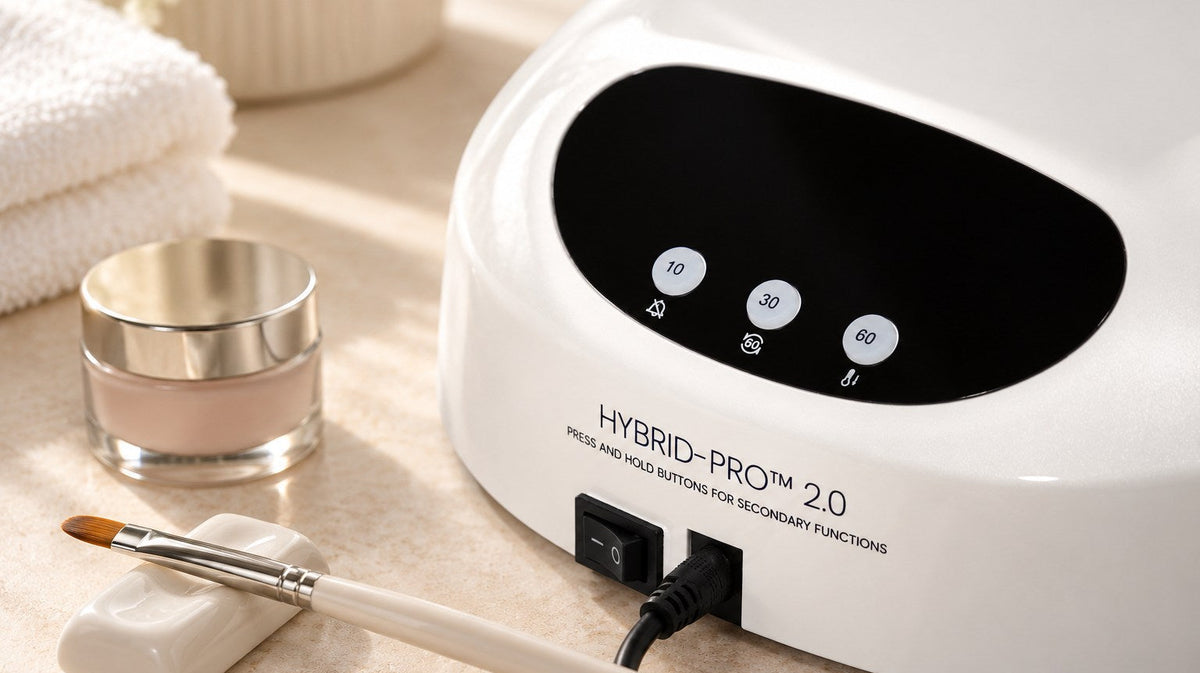
The Hybrid-Pro 2.0 offers a 60-second Low Heat mode, which Akzéntz says is intended to minimize heat spikes while maintaining complete curing. That feature is specific to its lamp and gels. Do not assume another lamp’s ‘low heat’ button behaves the same way or use the mode to shorten the exact gel’s required cure.
The Hybrid-Pro 2.0 is designed for complete curing across Akzéntz gel systems and includes a 60-second Low Heat mode intended to minimize heat spikes. Its product-specific timer and broad curing range make it a useful system lamp; still follow the exact gel’s full cure directions.
Read the current instructions for the exact gel, including the lamp family and cure time.
Check that the lamp is functioning, clean and used in the specified mode.
Position the client’s hand evenly so each nail sits within the lamp as directed.
Complete the full cure. Never reduce time or substitute a mode based on a guess about heat.
Pro Tip from NOVE Academy: Keep the gel name, lamp model and cure direction visible at your station. It is easier to check the pairing before application than troubleshoot from memory while a client waits.
Make the appointment feel predictable
After any spike, document what product and lamp were used, the layer being cured, the client’s description and what you changed according to the manufacturer. A pattern may help you identify a technique or system issue. Do not make a medical diagnosis or promise that a particular product or lamp will eliminate heat for every person.
Give the client a clear signal for pausing the cure.
Keep each layer controlled and away from surrounding skin.
Ask for feedback during the first cure and after any product change.
Stop when the client is not comfortable or a safe, correct cure cannot be confirmed.
Comfort and a complete cure go together
Heat spikes are a reason to listen, pause and check the service. They are not a reason to blame the client or improvise a shorter cure. Review the exact product, amount, nail condition and compatible lamp, then follow the full current instructions. If pain recurs or does not settle, end the service and help the client choose an appropriate next step.
A thoughtful gel service makes room for feedback. Explain what the client may feel, take discomfort seriously, and stay within the product maker’s instructions. That combination supports a calmer appointment and a properly completed service.
A Few Common Questions
Is it normal for gel to feel warm in the lamp?
Some warmth may be noticed as gel cures, but a sharp or painful heat spike should be taken seriously. Have the client remove their hand and pause while you check the application and exact product instructions.
Should a client keep their hand in the lamp through a heat spike?
No. If it hurts or feels sharply hot, stop the cure and let the client remove their hand. Do not ask them to endure pain.
Can I shorten the cure to reduce heat?
No. Follow the full cure time for the exact gel and lamp specified by its manufacturer. A shorter cure can leave the product under-cured.
Does every gel need the same low-heat setting?
No. Lamp modes and gel directions vary. Use a low-heat mode only when it is specified for that product system, and preserve the complete cure.
Will a low-heat lamp prevent all heat spikes?
No product or lamp can be promised to prevent heat for every client. Akzéntz describes its Hybrid-Pro 2.0 Low Heat mode as minimizing heat spikes while maintaining complete curing.
What if the client still has pain after removing their hand?
Stop the service and do not continue curing that application. If discomfort persists or there are concerning skin or nail changes, recommend appropriate health advice.
Pause, listen, and check the exact system
A client should never have to tolerate pain to finish a cure. Pause at a sharp heat spike, review the product and application, and follow the complete maker-specified cure with the compatible lamp.
Explore our NOVE Academy Guides for more practical product and technique advice, or ask the NOVE team for help choosing products for your service.
Professional education from NOVE Academy. Follow your training and the current instructions for your exact products and equipment. Product availability can change.


 ellpellz
View all reviews on Google
 Rowan Jeancart
 Kathy Heynemans
 ML M
 Morgen Schick
 Sydney Kolbeck
 sidra Akram
 Dinelle Lajeunesse
 Amanda Dietrich
 Trudy Sands
 lou gaudet
 Dean Prediger (Preds)
 Jessica Hueser
 Ashlyn Evans
 Shekinah Petten
 Shayla Millar
 blaze
 Kela Groeschel
 Shantell Redlick
 Hayley-Rae Gardipy
 Kim Calvert
 Rachel Mcgonigal
 Diane Newton
 Alissa Gaudet